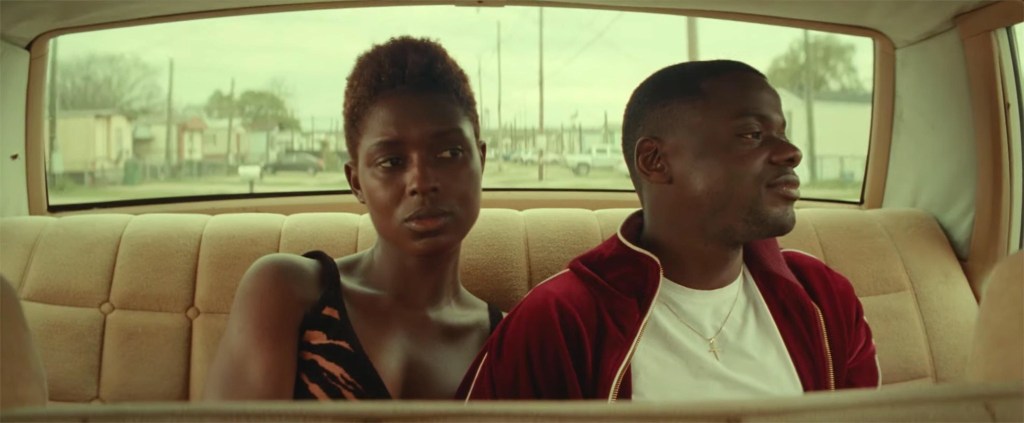
Developing Cinematography Alongside Narrative: Shot Framing in Queen and Slim
Spacing can tell you a lot about the relationship between two characters. However, when they’re confined to a 6x10ft car for the majority of the film, it can be difficult to vary the distance between two people. Such was the case in the film Queen and Slim. After Slim kills a cop in self defense, both he and Queen find a getaway car and hit the road. Since most of the film features the two in a car, shots could have easily become repetitive and boring. Luckily, director Melina Matsoukas and cinematographer Tat Radcliffe avoided this trap by altering the framing of shots. They especially took advantage of the natural frames the cars provided, which gave the film more visual depth and focus. While varying framing randomly wouldn’t have done much, they made sure to develop the cinematography alongside the story. An example of this change can be seen by comparing the framing of medium closeups of Queen and Slim in a car before and after their conversation in bed at Queen’s uncle’s house. This manipulation alongside the narrative was crucial in order to accurately convey the emotional state of Queen and Slim and the progression of their relationship as a team.
At the beginning, the cinematography decisions supported the acting and narrative by emphasizing the disconnect between the two protagonists. When Queen and Slim were first introduced their mannerisms, clothing, and feelings directly contradicted each other. They seemed incompatible. The framing of shots emphasized this when they were driving home after their terrible first date (00:17:00). Each medium close up of Slim was shot through the driver’s window and each medium close up of Queen was shot through the passenger’s window. Few shots, if any, featured them both at the same time. Both characters were also looking straight ahead or outside the car. Additionally, they were both leaning towards the doors. This made it seem as if the two characters could not want to be father apart. It put the audience outside the car and communicated their discomfort and disinterest. After killing the cop the framing stayed the same. In this context, the framing sent a message not just of discomfort, but of a separate, discordant duo that was going to struggle working together.


(Above, Queen in passenger seat and Slim driving around 00:17:00)
When they reach Queen’s uncle’s house, Queen and Slim’s relationship and accompanying shot framing change. As they layed in bed talking, they were once again confined to a limited space (00:48:00). Where previously they were hardly featured in the same shot together, now they both appeared in each shot. They shifted from staring at the ceiling to facing each other to turning away from each other. The birds eye shot gives the audience a view that they wouldn’t naturally have and illustrates the emotions the characters go through. They can’t change or pervert how close they are. They can’t deny that they are in this together. They are here side by side, facing the same path, the same fate. Anyone looking down can see that. Near the end of Queen and Slim’s heart to heart, they have a slight disagreement and turn back to back. This makes viewers wonder if things are going to stay the same and that they will never unite. However, Queen eventually turns around and faces Slim, showing that she’s not willing to go back to the disconnected way they were and that she now recognizes that they are a team with things in common.


(Above Queen and Slim lying on bed around 00:48:00)
The cinematography continued to develop alongside the narrative when they continued their journey after leaving Queen’s uncle’s house, but this time it showed a dramatic shift in their relationship. More shots featured them both in the same frame, the lighting was brighter with yellow tones, and more of the driving took place in the day time versus the night. The road now seemed to be full of possibility instead of daunting, dangerous things. They are on a journey going towards something instead of running away in an escape. There were still many medium closeups of them individually; however, this time the majority of them were taken through the front windshield. They were also sitting naturally – not leaning away – and faced each other more often. This made them seem happy to be in one another’s company. They were no longer divided. They physically appeared closer which translated to mental and emotional closeness and connection.


(Above Slim in passenger seat and Queen driving around 1:06:00)
Overall, the three scenes just analyzed provide an example of how cinematography changed in order to better communicate the progression of the story to the audience. However, it is important to note that there were many more scenes in which the decisions regarding cinematography helped develop the story into one that was engaging and comprehensive. In film, actions can often speak louder than words, so how that action is filmed, shot, and framed is equally important. The creators of Queen and Slim effectively did this, and they were rewarded with a dynamic movie that featured two characters that experienced a dramatic change in their relationship. Every film and its narrative is different, so making the correct choices concerning cinematography, specifically framing, is critical for the success of the story.
Works Cited
Matsoukas, Melina, et al. Queen and Slim. Universal Pictures Home Entertainment, 2020.
One of several screen reports and projects for JAMS 327: Introduction to Film, Race on Film
- This is one of three screen reports written for the course
- This presentation was done with one other student, evaluating shot and color grading
- Students watched eight films throughout the course, all of which concerned race in America
- Films Included:
- Queen and Slim
- Selma
- I Am Not Your Negro
- The Hate U Give
- Malcolm X
- Sorry to Bother You
- BlacKkKlansman
- Moonlight

